Loading...
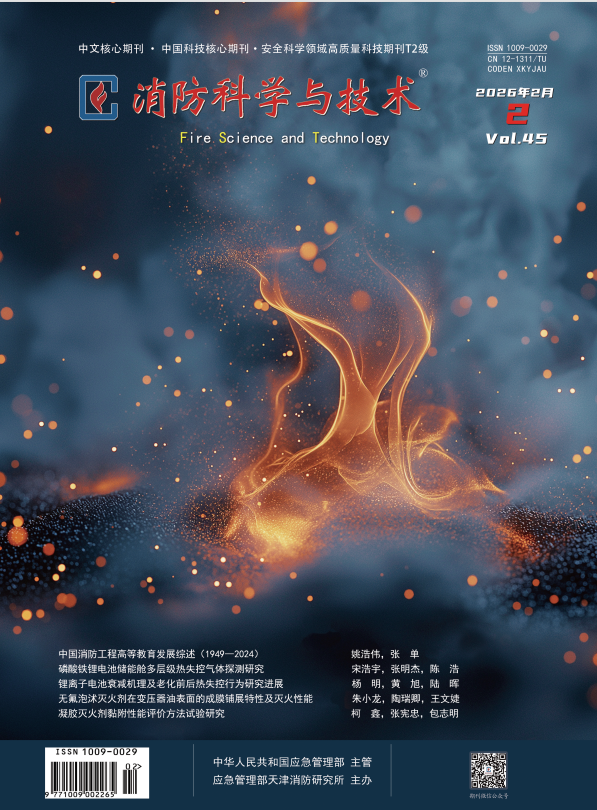
主管:中华人民共和国应急管理部
主办:应急管理部天津消防研究所
ISSN 1009-0029  CN 12-1311/TU

Table of Content

    15 February 2026, Volume 45 Issue 2 Previous Issue   

    For Selected: Toggle Thumbnails
    A review on the development of higher education in fire engineering in China (1949 to 2024)
    Yao Haowei, Zhang Dan
    2026, 45 (2):  1-12. 
    Abstract ( 132 )  
    With the acceleration of urbanization, the continuous expansion of industrial scale, and the increasing living standards of the people in our country, the emphasis and requirements for fire safety have grown, prompting the gradual rise and significant development and change of higher education in fire engineering. This paper systematically reviews the origin and evolution of higher education in fire engineering in China, categorizing its development into five stages: the early exploration and foundation-laying stage, the initialization and pioneering stage, the preliminary development stage, the rapid development stage, and the stage of deepening reform and comprehensive advancement. This paper analyzes the current state of fire engineering major construction in various universities. The number of new universities establishing fire protection engineering majors is increasing annually. The paper also discusses the development of related disciplines, which primarily rely on the fundamental discipline of safety science and engineering and feature a comprehensive talent cultivation system. Academic papers in the field of fire safety published by universities and research institutions were collected from the Web of Science Core Collection and Peking University Chinese Core Citation Database (2003 to 2024). An analysis was conducted on the overall output characteristics of scholarly publications, patterns of research collaboration, and research topics explored in these papers. This analysis aims to provide comprehensive and systematic reference materials for educators, researchers, and practitioners in the field of fire engineering, promoting the sustained progress and improvement of higher education in fire engineering in China.
    Related Articles | Metrics
    Study on the spreading law of continuous ethanol spill fire with different width of glass substrate
    Xia Meiqing, Ye Chenghao, Li Jiaxing, Zhang Peihong
    2026, 45 (2):  13-18. 
    Abstract ( 69 )  
    The wider the substrate of liquid fuel leakage and diffusion, the longer the unconfined multi-directional spreading process of the flowing fire, which increases its hazard. To investigate the effect of substrate width on the combustion characteristics of flowing fire such as diffusion combustion area and burning rate, a series of continuous leakage ethanol flowing fire tests were conducted. Five leakage rates (30, 50, 70, 90, 110 L/min) were set, and the width of the glass substrate of the rectangular flow channel was varied (0.05, 0.10, 0.15, 0.20, 0.25, 0.30 m). The results show that for the same leakage rate, the stable combustion area and maximum combustion area increase with increasing width, and this increasing trend is more pronounced at higher leakage rates. The heat loss of the fuel layer increases with the width of the substrate, leading to a decrease in the burning rate. Comparison of dimensionless burning rate models reveals that the burning rate of ethanol flowing fire on the glass substrate is higher than that on the steel substrate.
    Related Articles | Metrics
    Influence of ambient pressure and temperature on smoldering smoke generation and detection alarms
    Lu Rui, Huang Xin, Zhan Zhiming
    2026, 45 (2):  19-24. 
    Abstract ( 96 )  
    In order to study the effects of different environmental pressures and temperatures on the characteristics of smoldering smoke and the alarm time of detectors, smoldering tests were conducted on corrugated cardboard in environments of 40 kPa to 101 kPa and 0 ℃ to 40 ℃. The changes in fuel quality, smoke morphology, smoke temperature, obscuration coefficient, smoke velocity, and the detection and alarm time of three different types of smoke detectors were measured during the smoldering process under different environmental conditions. The results indicate that a decrease in environmental pressure can lead to a reduction in the rate of fuel mass loss during smoldering, as well as a decrease in the peak smoke volume fraction after complete combustion of the cardboard, resulting in a delay in smoke alarm time or even no alarm under low pressure conditions; Due to air resistance and reduced air density, smoke under low pressure conditions will have higher temperature and faster spread speed. The decrease in ambient temperature will also reduce the rate of fuel mass loss during the smoldering process, as well as lower the smoke temperature and spread rate, resulting in a slight delay in the smoke alarm time under low temperature conditions, but almost no change in the peak smoke volume fraction after complete combustion.
    Related Articles | Metrics
    Research and analysis of intelligent energy meter data under different electrical fault modes
    Wang Yuling, Yangjin Lamu, Du Rui, Li Shuchao, Cao Ruihan
    2026, 45 (2):  25-30. 
    Abstract ( 85 )  
    In order to accurately analyze the occurrence and development process of electrical fires, investigate the causes of fires in depth, design and build a fault simulation experimental platform, the load data and event record changes collected by intelligent energy meters during line faults were analyzed by simulating 6 electrical fault modes. The relevant laws between changes in electrical parameters and different electrical faults were studied. The results show that by extracting and analyzing the load data and event records collected by smart energy meters, it is possible to infer the type of electrical equipment usage, time axis and electrical faults at the fire scene. Combined with investigation and inquiry, on-site traces, technical identification, and simulation experiments, the complete process of the occurrence and development of electrical fires can be traced, providing strong data support for the investigation of the causes of electrical fires.
    Related Articles | Metrics
    Research on multi-level thermal runaway gas detection in lithium iron phosphate battery storage compartment
    Song Haoyu, Zhang Mingjie, Chen Hao, Yang Kai
    2026, 45 (2):  31-38. 
    Abstract ( 65 )  
    Lithium iron phosphate batteries under abusive conditions will experience thermal runaway, generating a large number of flammable and toxic gases, easy to cause fire or even explosion accidents, which has become a problem restricting the further development of lithium iron phosphate battery energy storage. In view of this, this paper built an experimental platform consistent with the real energy storage cabin. Lithium iron phosphate battery was taken as the experimental object to carry out the thermal runaway gas micro-leakage experiment at the level of battery cell, module and battery cluster. Spectral imaging device, combustible gas detector and visible light camera were used for the whole gas monitoring. The experimental results show that: the position of the gas detector has a great influence on the early warning time. The detector closer to the experimental position responds first, the peak time is the earliest, and the peak value is the largest. The H2 response speed of the detector at different positions is faster than that of CH4 and CO, so H2 can be used as the first-level early warning. In different levels of gas micro-leakage experiments, due to the spectral imaging device can be directly detected on the leakage location, so the CH4 and CO spectral imaging early warning time are earlier than the H2, CH4 and CO detector. The early warning time of CH4 spectral imaging is earlier than that of CO imaging, because the battery generates electrolyte vapor earlier than the release time of CH4 and CO in the early stage of the experiment, and CH4 imaging is more sensitive to volatile organic compounds (VOC). Spectral imaging detection earlier than the battery thermal runaway is greatly affected by obstacles, and can be combined with other detection methods for early warning and fault location.
    Related Articles | Metrics
    Research progress on degradation mechanism and thermal runaway behaviors before and after aging of lithium-ion batteries
    Yang Ming, Huang Xu, Lu Hui, Xue Feng, Cheng Xudong, Fu Yangyang
    2026, 45 (2):  39-48. 
    Abstract ( 65 )  
    During the service life of lithium-ion batteries, the increase in cycle numbers and service time will lead to battery aging at varying degrees. Aged lithium-ion batteries are more prone to self-heating and thermal runaway (TR) under mechanical, electrical and thermal abuse conditions, with their thermal stability and safety performance both degraded. Therefore, to ensure the safety of lithium-ion batteries during operation, it is urgent to explore the degradation mechanism and analyze the differences in thermal runaway behaviors before and after aging. This paper reviews the relevant research on the degradation mechanism and thermal runaway of lithium-ion batteries in recent years. Firstly, it systematically introduces the capacity degradation laws and aging mechanisms of lithium-ion batteries under abuse conditions such as high/low temperature, overcharge and high charge-discharge rates via two aging pathways: cycle aging and calendar aging. Then, a comprehensive analysis of the thermal runaway mechanism of lithium-ion batteries is carried out, including the thermal runaway process behaviors and the main chemical reactions in each stage. Meanwhile, the research results of domestic and foreign scholars on the thermal runaway behaviors of lithium-ion batteries before and after aging under different aging pathways are emphatically compared, and the intrinsic causes leading to the differences in thermal runaway behaviors of lithium-ion batteries are explored. The deficiencies existing in the current research are put forward, and the research priorities in the future are prospected finally.
    Related Articles | Metrics
    Experimental study on the morphological characteristics of methane jet fire impinging the circular tubes
    Zhang Shaogang, Fan Yongqiang, Li Chengqin, Cong Beihua
    2026, 45 (2):  49-54. 
    Abstract ( 53 )  
    This paper conducted a series of methane jet fire experiments under the action of pipelines and studied the influence of pipelines on jet flame morphological characteristics. The jet flame combustion process was recorded during the experiment and the flame visualization images were processed. The results show that vertical jet flame height increases with the increase of nozzle-pipe spacing, decreases with the larger pipe diameter; while the horizontal extension flame width underneath the pipe shows the contrary variation trends. A prediction model for vertical jet flame height under the action of horizontal pipelines was established based on the flame length model of jet fire, and verified by the previous results.
    Related Articles | Metrics
    Study on the influence of acetone vapor temperature on explosion limits
    Ji Pengfei
    2026, 45 (2):  55-58. 
    Abstract ( 51 )  
    Acetone is widely used as a common organic solvent, and temperature is the key factor affecting its explosion limits. Based on theoretical analysis, this paper determines the influence of temperature on explosion limits, and proposes a quantitative calculation method for the effect of temperature on acetone explosion limits. The algorithm reveals that the logarithmic ratio of the difference between the upper and lower acetone explosion limits at different temperatures has a linear relationship with the reciprocal difference of temperature, with a proportional coefficient of about -101.21. Experimental verification of the algorithm was carried out with a 20 L sphere explosion test apparatus. The results show that with the acetone vapor temperature rising from 25 ℃ to 115 ℃, the decrease ratio of the lower acetone explosion limit is about 3.0%, while the increase ratio of the upper explosion limit is about 6.0%, indicating that the effect of temperature on the upper explosion limit is greater than that on the lower one. The difference of explosion limits increases from 10.62% to 11.50%, with an increase ratio of about 8.3%. The experimental results verify the algorithm proposed in this paper.
    Related Articles | Metrics
    Subcritical velocity to maintain fire-induced smoke stratification in tunnels during construction with press-in ventilation
    Yu Junhao, Zhou Yao, Zhuang Zhaoyi, Zhao Shengzhong
    2026, 45 (2):  59-66. 
    Abstract ( 39 )  
    When a fire occurs in tunnels during construction, press-in ventilation is used to ensure evacuation safety by maintaining the smoke stratification stability on the downstream side. In this paper, the fire-induced smoke stratification characteristics in a tunnel during construction with press-in ventilation are studied by numerical simulation. The concept of subcritical velocity is proposed. The smoke layer height, thermal stratification intensity, and Fr number on the downstream side are analyzed. The subcritical velocity can control the smoke back-layering on the upstream side and the smoke stratification on the downstream side in an acceptable range at the same time. The subcritical velocity is also the critical value at which the smoke layer on the downstream side ranges from relatively stable to unstable. When ventilation velocity is less than subcritical velocity, the slopes of smoke layer height and thermal stratification intensity along the longitudinal direction of the tunnel decrease as ventilation velocity increases, and smoke stratification maintains relatively stable. When ventilation velocity exceeds subcritical velocity, smoke layer height and thermal stratification intensity rapidly decrease, and smoke stratification is destroyed. When the temperature ratio(ΔTcf/ΔTaver) and the Fr are used to characterize the smoke stratification, ΔTcf/ΔTaver is not sensitive to the Fr when the ventilation velocity is small.
    Related Articles | Metrics
    Study on the characteristics of polyurethane insulation material ignited by welding spatter
    Shen Xiaoyu, Zhang Shuchuan, Zhao Zongyu
    2026, 45 (2):  67-72. 
    Abstract ( 46 )  
    In order to explore the ability of welding beads igniting polyurethane board (PUR), the ignition probability model of PUR was established based on the experimental platform of welding bead preparation and high-speed camera to record the whole process of bead formation to fall, and analyze the influence of welding bead diameter, kinetic energy and welding distance on its ignition ability. The results show that the particle size of the ignition molten beads is mostly concentrated in the range of 1 mm to 3 mm, and the particle size of the non-combustible molten beads is mainly distributed in the range of 0 mm to 2 mm. The critical kinetic energy of molten bead is 0.12×10⁻⁴ J. When the welding distance is determined, the igniting ability increases with the increase of current. When the loading current is constant, the igniting ability becomes weaker with the increase of the welding distance. Through the analysis of the above factors and the use of Logistic regression model, the ignition probability model of PUR is established. The verification shows that the prediction accuracy of this model is high, and the probability of ignition of PUR insulation materials by electric welding beads can be preliminarily predicted.
    Related Articles | Metrics
    The inhibiting effect of water spray on fire and smoke in longitudinally-ventilated tunnel
    Liu Yuanjun, Gong Cheng, Tang Zhi, Gao Wenjie, Fang Zheng
    2026, 45 (2):  73-78. 
    Abstract ( 53 )  
    A series of reduced-scale tunnel fire tests were conducted to study the inhibiting effect of water spray on fire and smoke in longitudinally-ventilated tunnel. The influence of fire heat release rate, water spray flow rate and ventilation velocity were discussed. The results show that the water spray with a flow rate of 2.8 L/s and 5.8 L/s right above the fire source failed to extinguish a 3.6 MW fire, but reduced the required critical velocity by 50.0% and 66.7%, respectively. By analyzing the maximum temperature rise of ceiling smoke, it was found that water spray could enhance the cooling effect of longitudinal ventilation significantly, and the cooling effect is roughly linear with the spray flow rate.
    Related Articles | Metrics
    Study on agent leakage and mass compensation in total flooding gaseous fire extinguishing protection area
    Hou Zhenshan, Jin Kaiqiang, Zhang Qingshan, Sun Jinhua
    2026, 45 (2):  79-85. 
    Abstract ( 54 )  
    The enclosure integrity of total flooding gaseous fire suppression protected areas deteriorates annually, leading to attenuation of fire suppressant agent hold time, which significantly reduces the long-term reliability of fire suppression system performance. Therefore, it is essential to provide mass compensation for the original design dosage of fire suppressant agents. Building upon previous research, this paper analyzes the leakage patterns, hold time, and mass loss of perfluorohexanone within protected areas under quantified enclosure integrity conditions by establishing more uniformly distributed air leakage areas and developing simplified yet reliable simulation models. The results are compared with the ISO hold time prediction model. The findings demonstrate that the evolution of the "fire suppressant leakage-air mixing" pattern at leakage points across different levels causes non-monotonic evolution of the descending interface, whereas the ISO model's simplified assumptions ("top air intake/bottom leakage" and "single leakage morphology") result in monotonic evolution predictions of the descending interface. Under identical fire suppression concentration and protection height parameters, the ISO model significantly overestimates the hold time. Current standards such as ISO neither provide calculation methods for fire suppressant mass compensation nor address the potential misjudgment of hold time in their prediction models. For high-value protected facilities, the methodology proposed in this study enables simulation of complex leakage morphologies and precise quantification of fire suppressant mass compensation required to meet hold time specifications, thereby establishing a design basis for fire suppressant dosage in long-service-life protected areas.
    Related Articles | Metrics
    Research on the influence of nozzle structure on the injection noise of inert gas fire extinguishing agents
    Zhang Dehua, Li Zhaoyu, Xu Ru, Liu Lianxi,
    2026, 45 (2):  86-92. 
    Abstract ( 35 )  
    As an inert gas fire extinguishing system for protecting the fire safety of engine room of data centers, the high-intensity noise generated by the high-pressure inert gas sprayed from its nozzle during a fire can cause irreversible damage to a large number of mechanical hard drives in the data center. This article studies the overall noise intensity (Z-weighted) of existing inert gas nozzles during the spraying process and their noise intensity distribution in different frequency ranges. It is found that the generation of noise is mainly related to the relative flow velocity and flow state of the gas at the nozzle orifice. It has been verified through experiments that adding a loose and porous outer cover to the nozzle can effectively reduce spray noise, and optimizing the shape of the outer cover can further suppress high-frequency spray noise. Finally, the nozzle end pressure was achieved within the range of 0 MPa to 3 MPa, and the full frequency noise level was controlled below 100 dB, with good noise reduction effect, effectively ensuring the safety of the storage hard disk in the data center room during the operation of the inert gas fire extinguishing system, and having good application prospects.
    Related Articles | Metrics
    Comparative study on domestic and international standards of inflatable rescue boats
    Xing Ruize, Jiang Nan, Li Guohui, Ren Changxing, Tian Wenjie
    2026, 45 (2):  93-97. 
    Abstract ( 51 )  
    This study focuses on inflatable rescue boats, providing a comparative analysis of standards from major international organizations, including the International Maritime Organization (IMO) and the International Organization for Standardization (ISO), as well as representative countries and regions such as the European Union, Japan, and China. By examining the standardization frameworks and key performance testing standards for inflatable boats both domestically and internationally, it is observed that most Chinese standards are derived from or adapted from IMO and ISO benchmarks, with modifications introduced to better suit local needs. However, the absence of dedicated testing indicators and methods for rescue-specific performance constrains the wider application and advancement of inflatable boats in water rescue operations. In light of the distinctive demands of water rescue scenarios, this paper outlines a set of performance requirements for inflatable boats during rescue missions and proposes corresponding performance indicators and testing protocols in areas such as speed, safe-drop capability, and self-righting performance.
    Related Articles | Metrics
    Numerical simulation and analysis of water dropping from the belly-cabin of fire-fighting helicopters
    Wu Yingda, An Qiuze, Wu Ji, Huang Jiang, He Yuanhua
    2026, 45 (2):  98-105. 
    Abstract ( 55 )  
    A numerical simulation method based on the VOF-DPM approach combined with adaptive mesh refinement technology was employed to investigate the water dropping process from the belly-cabin of the H-125 helicopter at three airspeeds (5, 10, 15 m/s). The water dropping process from the belly-cabin involves the atomization phenomenon of the fire extinguishing agent working fluid, which is manifested as the process of a jet liquid column generating a liquid film and breaking to form liquid bands and droplets. The study reveals that regarding the lateral expansion of the fire extinguishing agent, with slight increases in airspeed, the velocity of air relative to the liquid increases, causing the momentum ratio to decrease and resulting in increased maximum lateral expansion width. Additionally, as the longitudinal height decreases, the lateral expansion width of the continuous liquid phase exhibits a trend of first increasing and then decreasing. In the analysis of droplet characteristics, with slight increases in airspeed, the droplet Weber (We) number increases, leading to more intense droplet breakup. This is specifically manifested as the critical diameter for droplet breakup gradually decreasing, making large-diameter droplets more prone to breaking into small-diameter droplets, thereby causing the relative frequency of small-diameter droplets to increase. This study provides theoretical support for the water dropping operations of fire-fighting helicopters and facilitates a deeper understanding of the water dropping process and governing mechanisms, which is of great significance for improving forest fire extinguishing efficiency.
    Related Articles | Metrics
    Fire rescue coverage efficiency calculation model based on open data
    Wu Fei, Luo Jie, Huang Zanhui, Liu Dingli
    2026, 45 (2):  106-112. 
    Abstract ( 53 )  
    Against the backdrop of insufficient number of fire stations in China, improving the coverage efficiency of fire rescue has become an important demand in the field of public safety. However, how to efficiently measure the effectiveness of fire rescue coverage remains a challenge faced by academia and industry. Using POI data to represent fire rescue demand points, with fire stations as fire rescue supply points; By calling on real-time traffic data available on the network map to simulate and calculate fire rescue response time, a fire rescue coverage efficiency calculation model based on hierarchical coverage weighting is constructed. By applying this model and considering the demand for building fire stations in Shaoyang City, 30 968 fire rescue demand points were collected, and 20 existing fire stations and 13 proposed fire stations were used as fire rescue supply points. 25 evaluation scenarios were set up, and a total of 1 297 025 valid samples were obtained. The calculation results show that after the proposed fire station is put into use, the coverage efficiency will increase by 20.47%, reaching 40.77 points. The specific situation is as follows: the coverage rate of less than 240 seconds will increase by 1.80%, reaching 9.09%; Within 240 s to 840 s, the coverage rate increased by 3.70%, reaching 27.51%; The coverage rate of more than 1 440 seconds decreased by 9.11% to 47.24%. Shaoyang City still needs to further strengthen the construction of fire stations. The constructed model can provide auxiliary support for the planning and construction of fire stations, and can also be applied to the calculation of fire rescue coverage efficiency in other cities.
    Related Articles | Metrics
    Film spreading characteristics and fire extinguishing performance of fluorine-free foam extinguishing agent on transformer oil surface
    Zhu Xiaolong, Zheng Yanran, Li Guochun, Tao Ruiqing, Wang Wenjie, Zhang Kai, Xu Jingyi, Zeng Lingfeng, Xu Chaohang
    2026, 45 (2):  113-121. 
    Abstract ( 40 )  
    Aqueous film-forming foam (AFFF) fire agents can effectively extinguish transformer oil fires, however, traditional AFFF contains PFOS, which is toxic and carcinogenic. Therefore, there is an urgent need to develop environmentally friendly foam agents that eliminate the use of PFOS. This study explores various combinations of active surfactants and analyzes their surface/interfacial properties. The findings reveal that there is a synergistic effect between hydrocarbon anionic surfactants and hydrocarbon nonionic surfactants, and a complementary effect between hydrocarbon anionic surfactants and either silicone nonionic surfactants or short-chain fluorinated surfactants. Additionally, a complementary effect was also observed between hydrocarbon anionic surfactants and fluorocarbon surfactants. Spreadability and fire tests demonstrate that the fluorine-free surfactant system proposed in this study performs comparably to the latest fluorinated eco-friendly foam agents in both spreadability and extinguishing efficiency and significantly outperforms commercial AFFF products.
    Related Articles | Metrics
    The effect of carbon-based materials on properties of flame retardant silicone rubber foam
    Lin Tao, Shang Ke, Yang Jinjun, Wang Junsheng
    2026, 45 (2):  122-127. 
    Abstract ( 51 )  
    To investigate the flame-retardant effect of carbon materials on silicone rubber foam, this study used five different types of carbon materials as flame retardants to prepare flame-retardant silicone rubber foam composites, and conducted a comparative analysis of their comprehensive properties. The results show that: the introduction of carbon materials affects the micromorphology of silicone rubber foam, leading to smaller pore size and pore wall, thereby changing the mechanical properties of the foam; among the five carbon materials, expandable graphite has the least impact on the mechanical properties of silicone rubber foam; compared with other carbon materials, expandable graphite and carbon nanotubes exhibit higher flame-retardant efficiency in silicone rubber foam. When their addition amount is only 1 part, the Limiting Oxygen Index(LOI) of silicone rubber foam can reach 28.0% and 28.2% respectively, and by vertical buring test, the flame retardancy rating can reach FV-0 grade; the silicone rubber foam with expandable graphite added has a high char residue (58.7%) at 900 °C, and its maximum thermal decomposition temperature is also significantly increased, showing good thermal stability; the cone calorimeter test results indicate that the total heat release and total smoke release of silicone rubber foam with expandable graphite and carbon nanotubes added are significantly reduced, which means it has higher fire safety.
    Related Articles | Metrics
    Experimental study on evaluation methods of adhesive property of gel fire extinguishing agent
    Ke Xin, Zhang Xianzhong, Bao Zhiming, Du Qiuyang
    2026, 45 (2):  128-133. 
    Abstract ( 42 )  
    Gel fire extinguishing agent is a kind of water based extinguishing agent which could be used in forest fire fighting. Its adhesion performance is the key factor to ensure its effective adhesion on trees and its advantages of high water retention. And the adhesion performance is also important for fire fighting, cooling and reducing water loss. However, at present, the evaluation methods of the specific properties of gel fire extinguishing agents, especially the adhesion performance, are still lacking. In this paper, two methods were proposed to evaluate the adhesion performance of gel fire extinguishing agents. And the adhesive properties of five commercially available gel fire extinguishing agents were tested and compared to verify the effectiveness and feasibility of the methods. According to the simulation degree of forest scene with two evaluation methods, the adhesion performance evaluation method of gel extinguishing agent based on wood dowel tree was selected. Through the test, the adhesion performance level of commercially available gel fire extinguishing agents was mastered. This study will provide technical support for the performance comparison of gel extinguishing agent products, the study of fire extinguishing mechanism and the development of new products.
    Related Articles | Metrics
    Urban safety emergency preparedness assessment methods and applications
    Zhang Xiaolei
    2026, 45 (2):  134-139. 
    Abstract ( 67 )  
    Effectively enhance urban safety emergency preparedness capabilities and quick response to emergency situations have become one of the basic abilities that modern urban managers must possess and key issues urgently needed to solve. This article proposes an evaluation method for urban safety response capability and constructs scientifically reasonable evaluation indicators by studying the urban safety emergency management system under the collaborative response mechanism of multiple departments and regions. Taking a certain city as the research object, an evaluation and analysis of its emergency preparedness capability was conducted, and weak links in the city's safety emergency management were identified. Research has shown that targeted improvement measures can enhance emergency response capabilities and urban disaster relief capabilities. Providing new scientific basis for urban safety governance and having certain practical significance and promotion value, this evaluation system can provide a new reference approach for emergency management capacity building in other large and medium-sized cities.
    Related Articles | Metrics
    Exploration on initial fire fighting and rescue mode of fire rescue team
    Zhao Yang
    2026, 45 (2):  140-144. 
    Abstract ( 86 )  
    In response to challenges such as increased fire rescue risks, shortened golden rescue time, and higher technical requirements, as well as existing problems including the disconnection between training and actual combat and insufficient operational formation efficiency, this paper takes Beijing's fire rescue work as the research object, and proposes the "three roles and five teams" formation mode, constructs an integrated operation system of "micro-station first response, small station forward deployment, and large station main combat", and innovates the "integration of training and combat" training mode, "multi-dimensional integration" command mode, and "four-in-one" support mode. Practice shows that after the reform, the success rate of fire extinguishing within half an hour has increased from 80% to 98%, and the physical skill qualification rate of the team has risen from 88% to 95%. In the future, it is necessary to further optimize modular formation and strengthen regional linkage to provide more efficient fire rescue solutions for coping with complex disaster scenarios.
    Related Articles | Metrics